Does mastic gum kill H. pylori? What the evidence shows

You’ve seen claims that mastic gum kills H. pylori. But is the evidence strong enough to try it, and what kind of results can you actually expect?
Mastic gum does show measurable activity against H. pylori in both laboratory and human studies. Some people achieve complete eradication, but many more experience symptom relief without fully clearing the infection. The distinction matters because killing bacteria can mean three different things:
Lab inhibition: Reducing bacterial growth in petri dishes or clinical samples. Important for understanding mechanism, but doesn’t predict human results.
Symptom improvement: Digestive discomfort, bloating, or pain improves even if H. pylori is still present. This is what most people experience.
Clinical eradication: Follow-up breath tests or stool antigen tests confirm zero detectable H. pylori. The gold standard, but harder to achieve.
For a complete overview of all mastic and H. pylori research, see how mastic gum protects against H. pylori infection.
Does mastic gum kill H. pylori?
Yes, but with important nuances. Human trials show that mastic can reduce H. pylori levels and improve symptoms, with eradication rates ranging from 30% to 92% depending on whether mastic is used alone or combined with standard antibiotics.12 Lab studies confirm direct antibacterial activity, with some experiments showing up to 90% reduction in H. pylori colonies.34
When you read that mastic “kills” H. pylori, check which endpoint the study actually measured. A 90% reduction in a lab doesn’t guarantee you’ll test negative after treatment.
What “killing” H. pylori actually means
Killing H. pylori is an umbrella term that masks three distinct outcomes:
Lab inhibition: Mastic reduces bacterial growth in petri dishes or clinical samples. Important for understanding mechanism, but doesn’t predict human results.
Symptom relief: Digestive discomfort, bloating, or pain improves even if H. pylori isn’t fully cleared. This is what most people experience.
Clinical eradication: Follow-up breath tests or stool antigen tests confirm zero detectable H. pylori. The gold standard, but harder to achieve.
Feeling better and testing negative are not the same thing. You can experience significant symptom relief while H. pylori levels drop but don’t disappear completely. Both outcomes are valuable, but if your goal is testing negative, you need to set different expectations than if your goal is feeling better.
Mastic as a natural remedy

Multiple peer-reviewed studies support using mastic as a natural remedy for H. pylori, both as a standalone approach and as part of combination therapy.
In human trials, mastic achieved complete eradication in some patients—9 out of 39 in one study using mastic alone,1 and 83 out of 90 (92.2%) when combined with standard antibiotics.2 Lab studies show even clearer antibacterial effects, with mastic reducing H. pylori colonies by 50-90% depending on concentration.34
Beyond clinical data, many people report noticeable symptom improvement after starting mastic, even when follow-up testing shows H. pylori is still present at lower levels.
What you can realistically expect
Most people experience symptom improvement: reduced bloating, discomfort, or digestive issues, even if H. pylori isn’t fully cleared. This is the most common outcome reported in studies and by users.
Partial reduction in H. pylori levels is also possible, confirmed by testing. The bacteria is still present but in smaller numbers.
Complete eradication is less common but documented, especially when mastic is combined with standard antibiotic therapy. In the 2023 trial, 92% of patients using mastic plus antibiotics achieved eradication, compared to 63% with antibiotics alone.2
If your goal is feeling better, mastic has strong support. If your goal is testing negative for H. pylori, it’s better positioned as part of a broader protocol rather than a standalone cure.
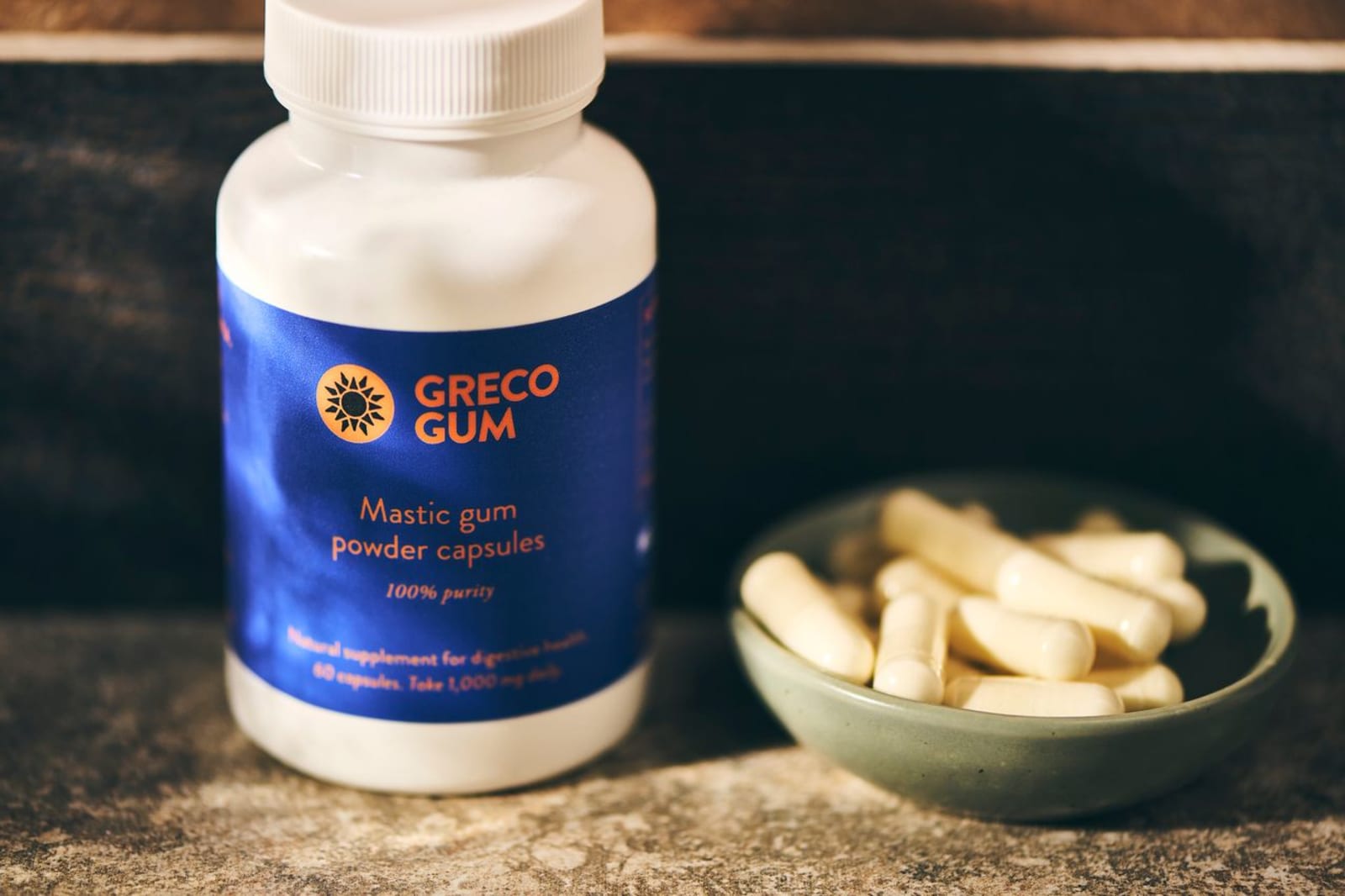
One thing that confuses people: the form matters. The studies showing eradication used powdered mastic in capsules, not chewed resin. When you chew mastic, most of the active compounds are absorbed through your mouth and don’t reach your stomach in concentrated form. If you’re treating H. pylori specifically, capsules are the better choice. For more on this, see how to take mastic gum for H. pylori.
Why mastic matters for antibiotic resistance
Mastic may be particularly valuable for people with antibiotic-resistant H. pylori strains or those who want to avoid antibiotics. The 2023 trial specifically noted that adding mastic to standard therapy could “reduce reliance on antibiotics and minimize the risk of resistance development.” This is important given rising rates of antibiotic-resistant H. pylori globally.2
Safety profile
In the 2010 trial, all 52 participants tolerated mastic well, with no serious side effects reported.1 The most common minor effects are occasional stomach discomfort or loose stools, particularly at higher doses.
For a fuller discussion of safety considerations and who should be cautious, see is mastic gum safe?
Human studies: What actually happens when people take mastic for H. pylori

The evidence for mastic and H. pylori comes from four main studies: two in humans and two in laboratory settings.
2010: Pure mastic gum tested in randomized controlled trial
A 2010 randomized controlled trial tested pure mastic gum against H. pylori in 52 patients, all confirmed positive via breath test before treatment.1 Researchers divided participants into four groups:
Group A (350 mg mastic, 3x daily, 14 days): 4 of 13 patients (31%) achieved eradication
Group B (1,050 mg mastic, 3x daily, 14 days): 5 of 13 patients (38%) achieved eradication
Group C (350 mg mastic + pantoprazole): 0 of 13 patients achieved eradication
Group D (standard triple antibiotic therapy): 10 of 13 patients (77%) achieved eradication
Mastic alone cleared H. pylori in roughly one-third of patients, lower than antibiotics, but significant for a natural remedy. Interestingly, combining mastic with a proton pump inhibitor (pantoprazole) showed no benefit, possibly due to drug interactions.
2023: Mastic added to antibiotic therapy dramatically improves outcomes
The strongest evidence for mastic comes from a 2023 trial of 180 patients testing whether adding mastic to standard antibiotic therapy improves outcomes.2
Control group: Standard triple therapy (antibiotics + proton pump inhibitor) achieved 63.3% eradication
Mastic group: Same antibiotics + 1 gram mastic daily achieved 92.2% eradication
Adding mastic increased eradication rates by nearly 30 percentage points. This matters because antibiotic-resistant H. pylori is becoming more common, and boosting the effectiveness of existing antibiotics could reduce the need for stronger drugs.
Lab studies: Direct antibacterial effects
Lab studies show what mastic can do to H. pylori bacteria directly. This is important for understanding mechanism, but it’s not a perfect predictor of results in living people.
2001: Mastic kills up to 90% of H. pylori strains
A 2001 lab study tested mastic against H. pylori samples at different concentrations:3
- Low concentration (125 μg/ml): Killed 50% of bacterial strains
- High concentration (500 μg/ml): Killed 90% of bacterial strains
Electron microscopy showed mastic physically damaged H. pylori cells, causing them to fragment and die.
1998: Mastic shows definitive antibacterial activity

In a 1998 study, researchers prepared mastic as a stock solution and tested it against H. pylori reference strains and fresh clinical isolates.4 Mastic killed every H. pylori population tested, reducing viable bacteria by a factor of 1,000 (leaving only 0.1% alive). Even at the lowest concentration tested (0.0075 mg/ml), bacterial growth was significantly inhibited.
Where to go from here
Mastic is one of the most evidence-backed options for natural H. pylori treatment.
For a complete overview of all H. pylori research, start with how mastic gum protects against H. pylori infection.
If you’re ready to try it, read how to take mastic gum for H. pylori for dosing, timing, and whether to chew resin or take capsules.
If you’re wondering how long to commit, see how long to take mastic gum for H. pylori for typical treatment timelines.
If you have safety concerns, read is mastic gum safe? for contraindications and side effects.
For more about mastic broadly, visit our mastic gum page.
If reflux or heartburn is your main complaint, see what the research shows about mastic gum for acid reflux.
FAQs
Can mastic gum help with H. pylori symptoms?
Yes. Even when mastic doesn’t fully eradicate H. pylori, many people report reduced bloating, stomach pain, and digestive discomfort. In clinical trials, symptom improvement was more common than complete eradication.
Can mastic gum cure H. pylori?
Cure isn’t the right word. Mastic can help eradicate the infection (fully clear it), but results vary. In the 2010 study, about one-third of patients using mastic alone tested negative afterward.1 When combined with antibiotics, eradication rates reached 92%.2 Think of it as a remedy that can work, not a guaranteed cure.
Does mastic gum eradicate H. pylori?
Sometimes. Eradication rates depend on whether you use mastic alone (30-38% in one study1) or combined with antibiotics (92% in another2). If your goal is complete eradication, mastic works best as part of a broader protocol.
Is mastic gum as effective as antibiotics?
Not as a standalone treatment. The 2010 study found standard triple antibiotic therapy achieved 77% eradication while mastic alone reached 31-38%.1 However, adding mastic to antibiotics boosted eradication rates to 92%, compared to 63% with antibiotics alone.2 Mastic amplifies antibiotic effectiveness rather than replacing it.
How long does it take for mastic gum to work for H. pylori?
Most studies used 14-day protocols, with participants testing 4-6 weeks after finishing treatment to confirm eradication. You may notice symptom improvement within the first week, but you won’t know if H. pylori is fully cleared without follow-up testing. For more detail, see How Long to Take Mastic Gum for H. Pylori.
What’s the best way to take mastic gum for H. pylori?
The human studies showing eradication used powdered mastic in capsule form (350-1,050 mg, 3x daily), not chewed resin.12 Capsules ensure the mastic reaches your stomach rather than being absorbed through oral tissues. For dosing details and timing, see how to take mastic gum for H. pylori. To understand the differences between chewing and swallowing, see mastic gum vs. mastic powder: Key differences, benefits, and best uses.
Are there side effects?
Mastic is well-tolerated by most people. In clinical trials, no serious adverse effects were reported.1 Minor side effects like temporary stomach discomfort or loose stools are occasional, usually at higher doses. For a full safety discussion, see is mastic gum safe?
This article originally appeared online in 2026; it was most recently updated on January 24, 2026, to include current information.

Eric Chin
Eric writes about ancestral nutrition, functional training, and ingredient purity. He’s a contributor to The WarKitchen, including “Flavors of Combat” (Issue 28) and “The Egg: Nature’s Perfect Food” (Issue 35).
References
References
-
Dabos, Konstantinos J., et al. “The Effect of Mastic Gum on Helicobacter pylori: A Randomized Pilot Study.” Phytomedicine 17, no. 3-4 (2010): 296-299. https://doi.org/10.1016/j.phymed.2009.09.010. PMID: 19879118. ↩ ↩2 ↩3 ↩4 ↩5 ↩6 ↩7 ↩8 ↩9
-
Addissouky, T. A., et al. “Assessing the Efficacy of a Modified Triple Drug Regimen Supplemented with Mastic Gum in the Eradication of Helicobacter pylori Infection.” American Journal of Clinical Pathology 160, Suppl. 1 (2023): S19. https://doi.org/10.1093/ajcp/aqad150.041. ↩ ↩2 ↩3 ↩4 ↩5 ↩6 ↩7 ↩8 ↩9
-
Marone, Paola, et al. “Bactericidal Activity of Pistacia lentiscus Mastic Gum Against Helicobacter pylori.” Journal of Chemotherapy 13, no. 6 (2001): 611-614. https://doi.org/10.1179/joc.2001.13.6.611. ↩ ↩2 ↩3
-
Huwez, Fawzi U., et al. “Mastic Gum Kills Helicobacter pylori.” New England Journal of Medicine 339, no. 26 (1998): 1946. https://doi.org/10.1056/NEJM199812243392618. PMID: 9874617. ↩ ↩2 ↩3