Does mastic gum kill candida?

Yeast infections and oral thrush caused by Candida overgrowth are common and difficult conditions, and mastic gum has been put forth as a potential treatment.1 Though studies are limited, research supports its antifungal properties.
What the research says about mastic and fungal organisms
The biggest barrier to the evidence that mastic gum can kill Candida is that there are no published clinical trials that tested directly on humans.
Studies showing mastic kills Candida all tested in petri dishes rather than on people, and some were performed using mastic tree leaves, not the resin you’d actually chew.
A 2020 study tested the effects of mastic leaf essential oil against two types of Candida, and another in 2014 tested various natural plant extracts, including mastic gum, against oral microorganisms.23 They both saw varying levels of promise, but again, not on overgrowth in humans.
Most of the human research related to mastic gum is for the treatment of H. pylori infection, but research has tentatively linked Candida and H. pylori.4 They can co-occur and act synergistically. H. pylori may have the ability to dwell in Candida vacuoles, using their structure as protection. The H. pylori cells can then multiply and spread inside the vacuoles.4 This means that H. pylori research is relevant and important to Candida researchers and vice versa.
How mastic might work against fungi
In the various studies, mastic was able to both stop the spread of and kill Candida.23 Researchers are not positive how mastic does this, but there are some theories.
Mastic resin contains a cocktail of plant compounds that together damage fungal cell walls and disrupt energy production inside the cell.5 Each individual compound of mastic gum is not as effective at killing fungus. Some have no effect at all on their own. But the combination of all of them working synergistically gives mastic its antifungal properties.
These compounds are present in both mastic chewing gum and capsules.
Chewing gum vs. capsules for candidiasis
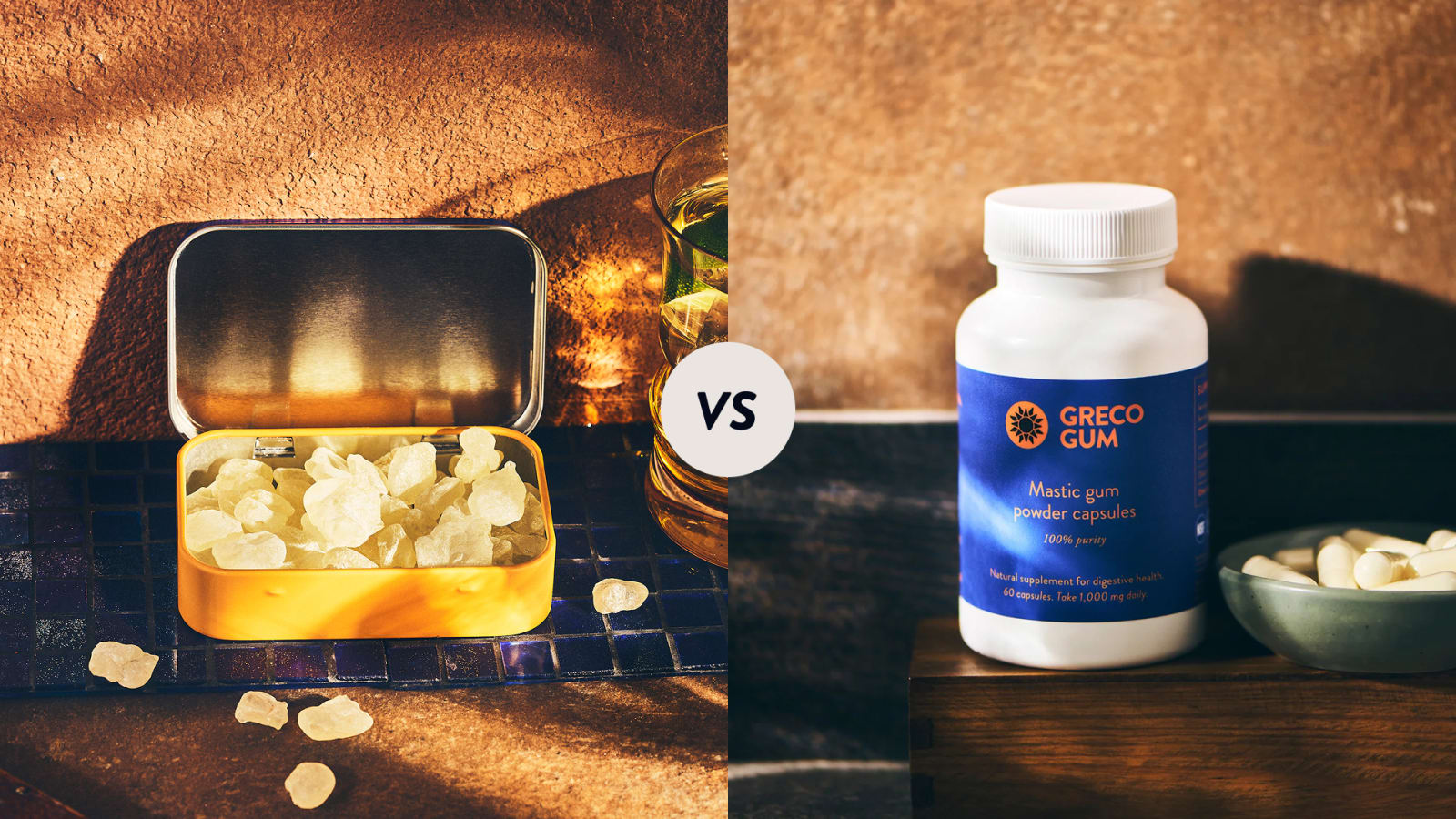
In general, we recommend mastic chewing gum for oral health and capsules for gut health.
Oral thrush is frequently the way people discover they have Candida overgrowth. For this kind of overgrowth, mastic chewing gum is the best method since the resin makes direct contact with your mouth and throat. When dealing with a yeast infection or Candida in the gut, capsules may be the better option. The critical antifungal compounds can work directly in your digestive tract.
Some people use both regardless of whether they have oral or gut-related overgrowth. Once you’ve decided what to take, you’ll need to know how much and how often to take it.
Recommended dosing and timeline of mastic gum
For oral health, we recommend chewing for 10-15 minutes for the first three weeks and increasing gradually until you can chew for at least 20 minutes.
If your goal is gut health, start with 5-10 minutes of chewing for the first three weeks and follow the same process until at least 15 minutes is comfortable.
To take mastic capsules for your gut, start with 350 mg of mastic powder three times a day. If after a few days you have no negative reaction, you can try 500-700 mg doses.
We recommend you read our in-depth timeline for how long to chew based on your goal before starting. Capsule consumers can check out our article on proper capsule dosing.
What to expect for symptom improvement

Even though there have been no human trials of mastic against Candida, the improved symptoms of those who have tried it point to what it can potentially do.
Bloating and gas are often first to improve. You may also have increased energy and, if you have oral thrush, clearing up of oral symptoms.6 Brain fog tends to take longer to clear than digestive symptoms like bloating and gas. You probably won’t see a clean Candida test result right away, but if your symptoms are notably better, then mastic gum is likely helping.
We don’t know exactly how quickly mastic gum will start working, but most people who report improvement see it within a few weeks of consistent use.
- At two weeks, you may start seeing improvement, especially of digestive symptoms.
- By six weeks, you should be able to tell if mastic is or isn’t working based on your improvement and whether you have die-off symptoms.
- If mastic gum is working for you and you don’t have any adverse reaction to it, you can continue using it for as long as Candida overgrowth persists.
Only continue chewing if your symptoms are improving.
Die-off symptoms vs. mastic side effects
Healthline states that Candida die-off symptoms can make you feel like you have the flu. They come on suddenly and range in severity.7 Symptoms include:
- Fever
- Chills
- Muscle aches
- Skin rash
- A rapid heart rate
Die-off happens when your body reacts to the toxins that yeast releases when it is broken down during antifungal treatment.7 Your first instinct may be that these symptoms are side effects of mastic gum, but they’re actually completely normal reactions your body may have to the byproducts of die-off. They tell you that your treatment is working.
If you’re worried, a doctor could confirm if what you’re experiencing is normal. Documented mastic allergies have been contact dermatitis or respiratory reactions, not reactions from oral consumption, and customer complaints of gastrointestinal side effects from Greco Gum are rare. However, your body may tolerate mastic differently than most, so it’s important to be attentive to any reaction that doesn’t fit typical die-off symptoms.
It’s best to stop taking mastic gum if you don’t feel any difference after four to six weeks of consistent daily use.
When to consider mastic as part of Candida treatment, and when to look elsewhere

Many people find it useful to get a professional diagnosis of their candidiasis before trying any kind of treatment.
Mastic gum can work alongside any other antifungal treatment or as a stand-alone. Improvement is more likely if you pair it with a Candida cleanse diet or other antifungals like oregano oil.
For clear-cut candidiasis symptoms, you can choose to use mastic on its own without getting an official diagnosis, but we recommend seeing a doctor if serious symptoms persist without any improvement or if symptoms worsen.
If you’ve decided mastic is worth a try for what you’re dealing with, the source matters. The antifungal evidence is on Chios resin, not on the adulterated or low-quality varieties that dominate the market.
Is mastic gum antifungal?
Yes, mastic gum has been found to have antifungal properties. We get our strongest testimony to this from a Milia et al. study in 2020 that tested mastic leaf essential oil on Candida and research by Karygianni et al. in 2014 that used mastic gum to kill oral microorganisms. Researchers believe that the organic plant compounds found in mastic resin work together to kill fungus.
How long does it take for mastic gum to start working?
No human trials have measured a timeline. Most people who report symptom improvement see it within two to three weeks of consistent use.
Does mastic gum heal your gut?
Yes, mastic gum has many anti-inflammatory, antioxidant, and antibacterial properties that make it effective in treating digestive and gastrointestinal issues. Our blog post on gut health goes deeper into this.
What bacteria does mastic gum kill?
Mastic gum kills many harmful oral and gut bacteria. For more information, check out our article explaining mastic gum’s antibacterial benefits.
This article originally appeared online in 2026; it was most recently updated on May 28, 2026, to include current information.

Beatrix Turajski
Beatrix is a health and wellness writer with two blogs and a special passion for mental health, fitness, and nutrition. Her career has taken her from creative writing to interning to freelancing.
References
-
Milia, E., et al. “The Pharmaceutical Ability of Pistacia lentiscus L. Leaves Essential Oil Against Periodontal Bacteria and Candida sp. and Its Anti-Inflammatory Potential.” Antibiotics Volume 9, 6(2020). doi.org ↩ ↩2
-
Karygianni, L., et al. “High-Level Antimicrobial Efficacy of Representative Mediterranean Natural Plant Extracts against Oral Microorganisms.” BioMed Research International doi.org ↩ ↩2
-
Braksator, J., et al. “Co-Occurrence of Helicobacter pylori and Candida spp. Infections in the Pathogenesis of Gastrointestinal Diseases.” Biomedicines Volume 13, 5(2025). doi.org ↩ ↩2
-
Huang, W., et al. “Biosynthesis Investigations of Terpenoid, Alkaloid, and Flavonoid Antimicrobial Agents Derived from Medicinal Plants.” Antibiotics Volume 11, 10(2022). doi.org ↩
-
“How To Know If Your Candida Is Gone.” IBS Treatment Center ibstreatmentcenter.com ↩
-
“What a Candida Die-Off Is and Why It Makes You Feel So Lousy.” Healthline healthline.com ↩ ↩2