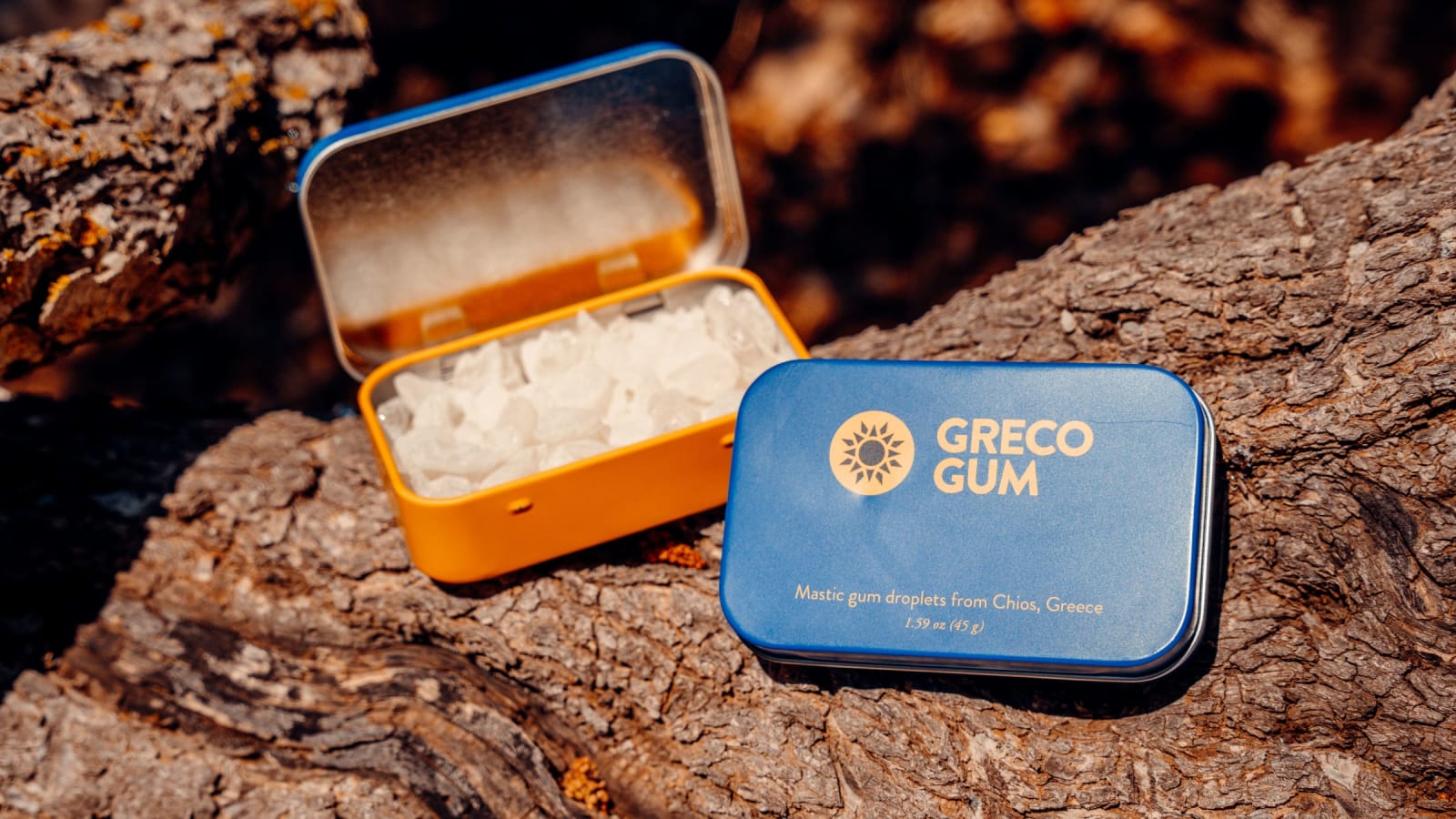
Why mastic gum sticks to your teeth (and how to stop it)

Why mastic gum sticks
Mastic gum is a fully natural product, made from the crystallized resin of the mastic tree. The hardened resin varies in shape, size, and consistency—and is sensitive to heat.
The moisture content of mastic (how much water is present) will determine its hardness and its vulnerability to melting in warmer environments. Larger pieces of mastic gum are usually softer than the smaller pieces because they retain more moisture. The higher moisture content of these nuggets also make them more susceptible to melting than the smaller droplets.
A simple fix for mastic gum that sticks
The best solution for mastic gum that sticks to your teeth is simple: just chew more.
When the softer pieces become too chewy and sticky, they should be rebalanced with harder pieces. Conversely, you can make a hard piece of mastic gum easier to chew by adding in softer pieces. Mastic sticks to mastic, so (in addition to getting the chewing consistency you want) adding more will pull any loose bits of sticky mastic off your teeth and incorporate it back into the main piece.
Look through your tin and examine different pieces by giving them a slight squeeze. You will notice some pieces are harder and some are softer. Squishier pieces will give a softer chew, while harder pieces will give a tougher one. Over time, you’ll examine more pieces and have a better idea of how to achieve your ideal chewing consistency.
To save future chewing sessions from sticky messes and excessive amounts of mastic gum, scan the pieces in your tin before creating a new wad. Balance sizes and textures to create the consistency you want. If our mastic nuggets are too squishy for your liking, we recommend trying our mastic droplets.

What to do with too much mastic
You might add a large amount of gum to get the consistency you want… possibly even too much mastic gum to enjoy or properly chew for jawline enhancement.
If you have more chewing gum than you’d like, simply tear off the amount you don’t want and save it for a later time. Mastic gum is naturally antibacterial, so it’s fine to rechew the same piece multiple times.
Our response to sticky mastic concerns
If you’ve experienced mastic gum that sticks to your teeth, you’re not alone. We’re writing this article because we’ve received emails and social media messages from customers who have run into the same sticky situation. They read about the incredible health benefits and aesthetic jawline improvements you can get from chewing mastic gum, then make their purchase. After a few days, they receive their tin and start chewing. Immediately, their jaw muscles feel the difference between mastic chewing gum and conventional chewing gum.
After some time chewing, they realize their mastic gum isn’t tough anymore. Instead, they struggle to keep the gum off of their teeth and in one piece. As first-time chewers, they question if this is what chewing mastic gum is really like.
Stickiness hinders the chewing experience. If squishy pieces cause this issue, then why don’t we only harvest the hard pieces and not the soft ones? Our product is directly from nature and not some mass-production industrial factory. Since nature yields resin pieces of varying shape, size, and hardness, we can’t exactly control how each individual piece will turn out.
“The entire production and cleaning process of Chios Mastiha is free of all chemicals and additives and has remained unchanged throughout the centuries” (Chios Mastiha Growers Association)

Why Greco Gum tins have fewer sticky pieces
As part of a careful labor-intensive process, resin is harvested from mastic trees (Pistacia lentiscus var. Chia) on the Greek island of Chios. The intricate stages of drying, cleaning, and sorting take months to accomplish before they can be sent for grading and further processing.
For more on the ancient Greek techniques used to harvest mastic resin and the timeline of mastic gum production, check out the article we wrote after our 2024 visit to Chios: how mastic gum is harvested.
When the grading is done, only the highest-quality mastic gum makes it to us for additional sorting and filtering. We examine each piece of resin to remove as many soft ones as possible. We try to filter as thoroughly as possible, but we are human, so some find their way into our tins. Additionally, some pieces are hard to the touch and only become soft once you start chewing.
Start sculpting a more defined jawline. Improve both your oral health and gut health with the antiplaque1, anti-inflammatory2, antioxidant3, antibacterial4, and antimicrobial5 properties that come with chewing mastic gum. Experience the health benefits of our Chios mastic gum for yourself.
This article originally appeared online in 2025; it was most recently updated on July 24, 2025, to include current information.

Eric Chin
Eric writes about ancestral nutrition, functional training, and ingredient purity. He’s a contributor to The WarKitchen, including “Flavors of Combat” (Issue 28) and “The Egg: Nature’s Perfect Food” (Issue 35).
References
-
Takahashi, K., M. Fukazawa, H. Motohira, et al. “A Pilot Study on Antiplaque Effects of Mastic Chewing Gum in the Oral Cavity.” Journal of Periodontology 74, no. 4 (April 2003): 501–505. doi: 10.1902/jop.2003.74.4.501. ↩
-
Triantafyllou, A., A. Bikineyeva, A. Dikalova, et al. “Anti-inflammatory Activity of Chios Mastic Gum Is Associated with Inhibition of TNF-Alpha Induced Oxidative Stress.” Nutrition Journal 10 (June 6, 2011): Article 64. doi: 10.1186/1475-2891-10-64. ↩
-
Rahman, H. S. “Phytochemical Analysis and Antioxidant and Anticancer Activities of Mastic Gum Resin from Pistacia atlantica Subspecies kurdica.” OncoTargets and Therapy 11 (August 6, 2018): 4559–4572. doi: 10.2147/OTT.S170827. ↩
-
Aksoy, A., N. Duran, and S. Toroglu. “Short-Term Effect of Mastic Gum on Salivary Concentrations of Cariogenic Bacteria in Orthodontic Patients.” Angle Orthodontist 77, no. 1 (January 2007): 124–128. doi: 10.2319/122205-455R.1. ↩
-
Koychev, S., H. Dommisch, H. Chen, and N. Pischon. “Antimicrobial Effects of Mastic Extract Against Oral and Periodontal Pathogens.” Journal of Periodontology 88, no. 5 (May 2017): 511–517. doi: 10.1902/jop.2017.150691. ↩