Why it’s safe to swallow raw mastic gum

Is it safe to swallow mastic gum?
Yes, mastic gum is safe to swallow. Chios mastic has been harvested for over 2500 years and was first mentioned by Hippocrates, a man who many regard as the “founding father of medicine.” The Greek philosopher and physician noted the medicinal properties of mastic, using it to effectively treat gastrointestinal issues.1 People still currently consume mastic resin due to its therapeutic effect on digestive issues, showing that it is indeed safe to swallow mastic (in both gum and powder form).
Note: as with any food, swallowing mastic gum may present a choking hazard. We recommend that you break it up into smaller bits before swallowing. Avoid swallowing larger chunks to limit potential dangers like choking. To minimize risks, chew and swallow responsibly.
Oral health benefits of mastic gum
Unlike other chewing gums that are filled with different additives, chemicals, and fillers, Chios mastic gum is 100% natural and safe to swallow. Mastic consumption and its safety dates back to ancient Greece, where it was prescribed as a treatment to aid digestion and alleviate gut discomfort.
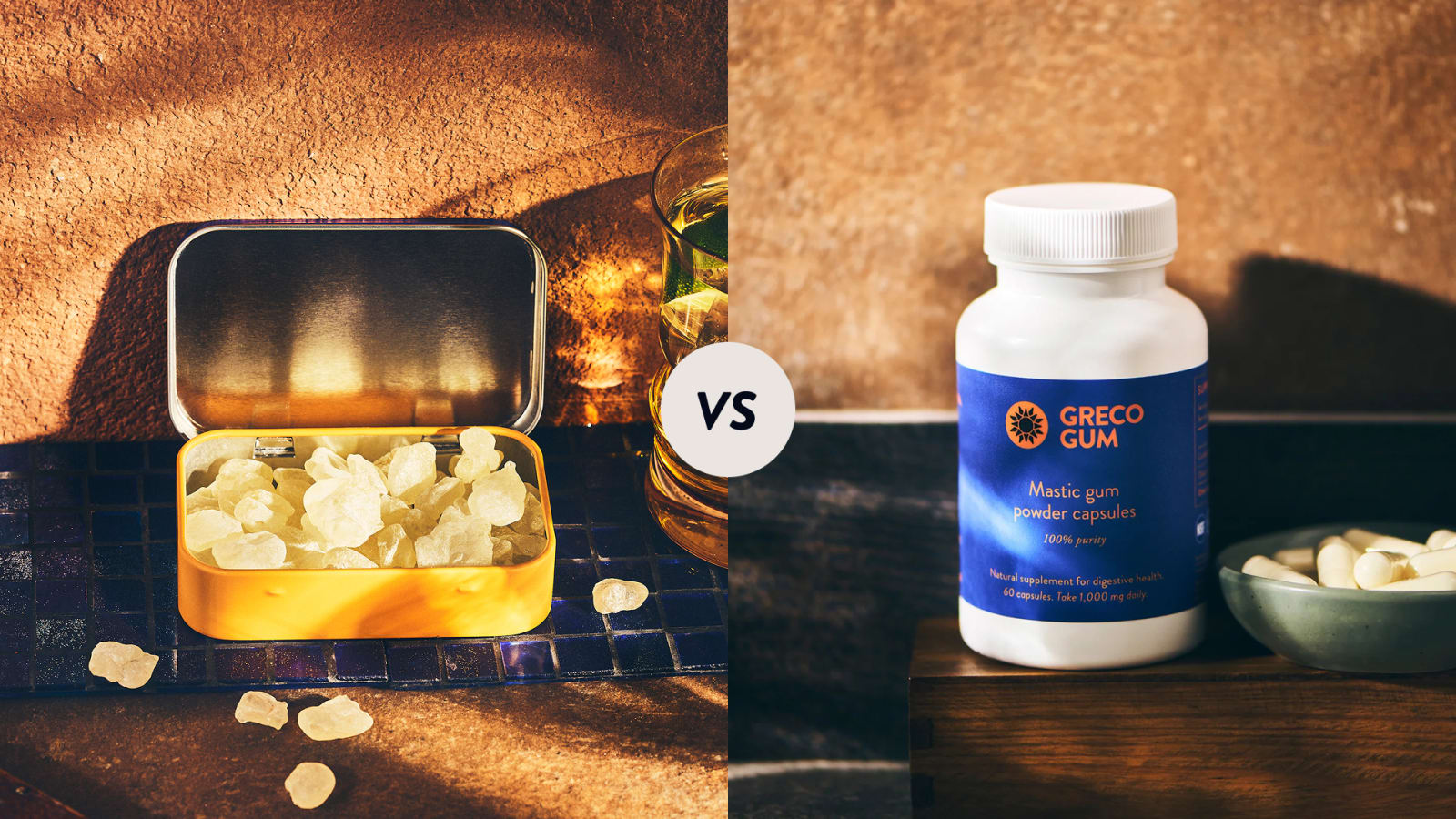
Choking hazard is the only potential cause for concern when swallowing mastic gum, but this can be avoided by breaking the gum into small pieces before swallowing. For those worried about the dangers of choking, mastic can be taken in an alternative powder capsule form.
In addition to droplets and nuggets, mastic resin is also ground into a fine powder. This mastic gum powder is usually taken on an empty stomach with water, acting as a natural supplement with great gut health benefits (see next section for more).

On its own, chewing mastic can provide numerous oral health benefits. Its antiplaque properties help prevent the buildup of plaque234 and accumulation of debris inside the mouth, while its antifungal properties help fight off oral fungi5. If left unchecked, these conditions can become a breeding ground for harmful bacteria and lead to a number of oral health issues.
Chios mastic also offers antimicrobial and antibacterial properties.16 Both inhibit the growth of harmful pathogens in the mouth, which is one of the most effective ways to prevent future disease, illness, and infections. Numerous studies have shown significant reductions in salivary bacteria levels before and after chewing mastic gum.2789
Outside of oral health, mastic gum may provide additional health benefits for the gut. After food is swallowed, the body breaks it down to use for its nutritional content.
Whether you swallow mastic gum or simply consume mastic powder, your body will be digesting the same thing. Both are resin from the mastic tree and boast all of its benefits, just in different forms.
Gut health benefits of mastic gum

Gastrointestinal (GI) diseases can cause a variety of digestion issues, pain, and discomfort. Various studies show that mastic gum could help fight against gastrointestinal disorders through its anti-inflammatory and antioxidant activity610.
The anti-inflammatory properties1610 of Chios mastic can help lower inflammation throughout the digestive system. In multiple studies, mastic powder has significantly reduced inflammation in experimental colitis101112 and inflammatory bowel diseases (IBD)13.
In addition, antioxidant compounds1610 found in mastic (like terpenes and polyphenols) can protect the gut against oxidative stress caused by free radicals14. By reducing gut inflammation and oxidative damage, mastic gum helps to promote healthier function of the digestive system and the immune system.
These anti-inflammatory and antioxidant activities make a powerful team in protecting the gut, supporting vital components of the digestive system, and alleviating painful symptoms of GI diseases. A more in-depth explanation of mastic gum’s gut health benefits can be found here.
Looking to improve your oral health? Want to give a boost to your gut health?
Experience the benefits of mastic for yourself and join over 52,000 satisfied customers:
This article originally appeared online in 2025; it was most recently updated on September 5, 2025, to include current information.

Eric Chin
Eric writes about ancestral nutrition, functional training, and ingredient purity. He’s a contributor to The WarKitchen, including “Flavors of Combat” (Issue 28) and “The Egg: Nature’s Perfect Food” (Issue 35).
References
-
Soulaidopoulos, Stergios, Aikaterini Tsiogka, Christina Chrysohoou, et al. “Overview of Chios Mastic Gum (Pistacia lentiscus) Effects on Human Health.” Nutrients 14, no. 3 (2022): 590. doi.org. PMID 35276949; PMCID PMC8838553. ↩ ↩2 ↩3 ↩4
-
Takahashi, K., M. Fukazawa, H. Motohira, et al. 2003. “A Pilot Study on Antiplaque Effects of Mastic Chewing Gum in the Oral Cavity.” Journal of Periodontology 74, no. 4: 501–505. doi.org. PMID 12747455. ↩ ↩2
-
Topitsoglou-Themeli, V., P. Dangalis, and D. Lambrou. 1984. “Chios Mastiha and Oral Hygiene I: A Possible Measure for Decrease of Microbial Plaque Formation.” Hellenic Stomatological Chronicles 28: 166–170. PMID 6599089. ↩
-
Topitsoglou-Themeli, V., A. Kolokotronis, P. Dangalis, et al. 1985. “Chios Mastiha and Oral Hygiene II: Differentiation in Microbial Plaque Formation.” Redodontia 2: 56–59. ↩
-
Ali-Shtayeh, M. S., and S. I. Abu Ghdeib. 1999. “Antifungal Activity of Plant Extracts Against Dermatophytes.” Mycoses 42: 665–672. doi.org. PMID 10680445. ↩
-
Tabanca, Nurhayat, Ayse Nalbantsoy, Paul E. Kendra, Fatih Demirci, and Betul Demirci. “Chemical Characterization and Biological Activity of the Mastic Gum Essential Oils of Pistacia lentiscus var. chia from Turkey.” Molecules 25, no. 9 (2020): 2136. doi.org. ↩ ↩2 ↩3 ↩4
-
Aksoy, A., N. Duran, S. Toroglu, et al. 2007. “Short-Term Effect of Mastic Gum on Salivary Concentrations of Cariogenic Bacteria in Orthodontic Patients.” Angle Orthodontist 77, no. 1: 124–128. doi.org. PMID 17029554. ↩
-
Sakagami, H., K. Kishino, M. Kobayashi, et al. 2009. “Selective Antibacterial and Apoptosis-Modulating Activities of Mastic.” In Vivo 23: 215–224. PMID 19414406. ↩
-
Al-Mofarji, T., N. R. Al-Zahid, and E. H. Al-Hashimy. 2013. “Antibacterial Effect of Mastic Gum on Aerobic Oral Bacteria.” Iraqi National Journal of Nursing Specialties 26, no. 2: 136–140. doi.org. ↩
-
Cui, H., X. Li, X. R. An, W. Liu, and T. Yuan. “Masticadienonic Acid from Chios Mastic Gum Mitigates Colitis in Mice via Modulating Inflammatory Response, Gut Barrier Integrity and Microbiota.” Phytomedicine 108 (2023): 154518. doi.org. PMID 36403513. ↩ ↩2 ↩3 ↩4
-
Gioxari, A., A. C. Kaliora, A. Papalois, et al. “Pistacia lentiscus Resin Regulates Intestinal Damage and Inflammation in Trinitrobenzene Sulfonic Acid-Induced Colitis.” Journal of Medicinal Food 14, no. 11 (2011): 1403–1411. doi.org. PMID 21612460. ↩
-
Papalois, A., A. Gioxari, A. C. Kaliora, et al. “Chios Mastic Fractions in Experimental Colitis: Implication of the Nuclear Factor κB Pathway in Cultured HT29 Cells.” Journal of Medicinal Food 15, no. 11 (2012): 974–983. doi.org. PMID 22891614. ↩
-
Papada, E., A. Gioxari, C. Amerikanou, et al. “Regulation of Faecal Biomarkers in Inflammatory Bowel Disease Patients Treated with Oral Mastiha (Pistacia lentiscus) Supplement: A Double-Blind and Placebo-Controlled Randomised Trial.” Phytotherapy Research 33, no. 2 (2019): 360–369. doi.org. PMID 30450689. ↩
-
Papada, E., A. Forbes, C. Amerikanou, et al. “Antioxidative Efficacy of a Pistacia Lentiscus Supplement and Its Effect on the Plasma Amino Acid Profile in Inflammatory Bowel Disease: A Randomised, Double-Blind, Placebo-Controlled Trial.” Nutrients 10, no. 11 (2018): 1779. doi.org. PMID 30453494; PMCID PMC6267573. ↩